Award-winning
Juicy Lucys
What is a Juicy Lucy?
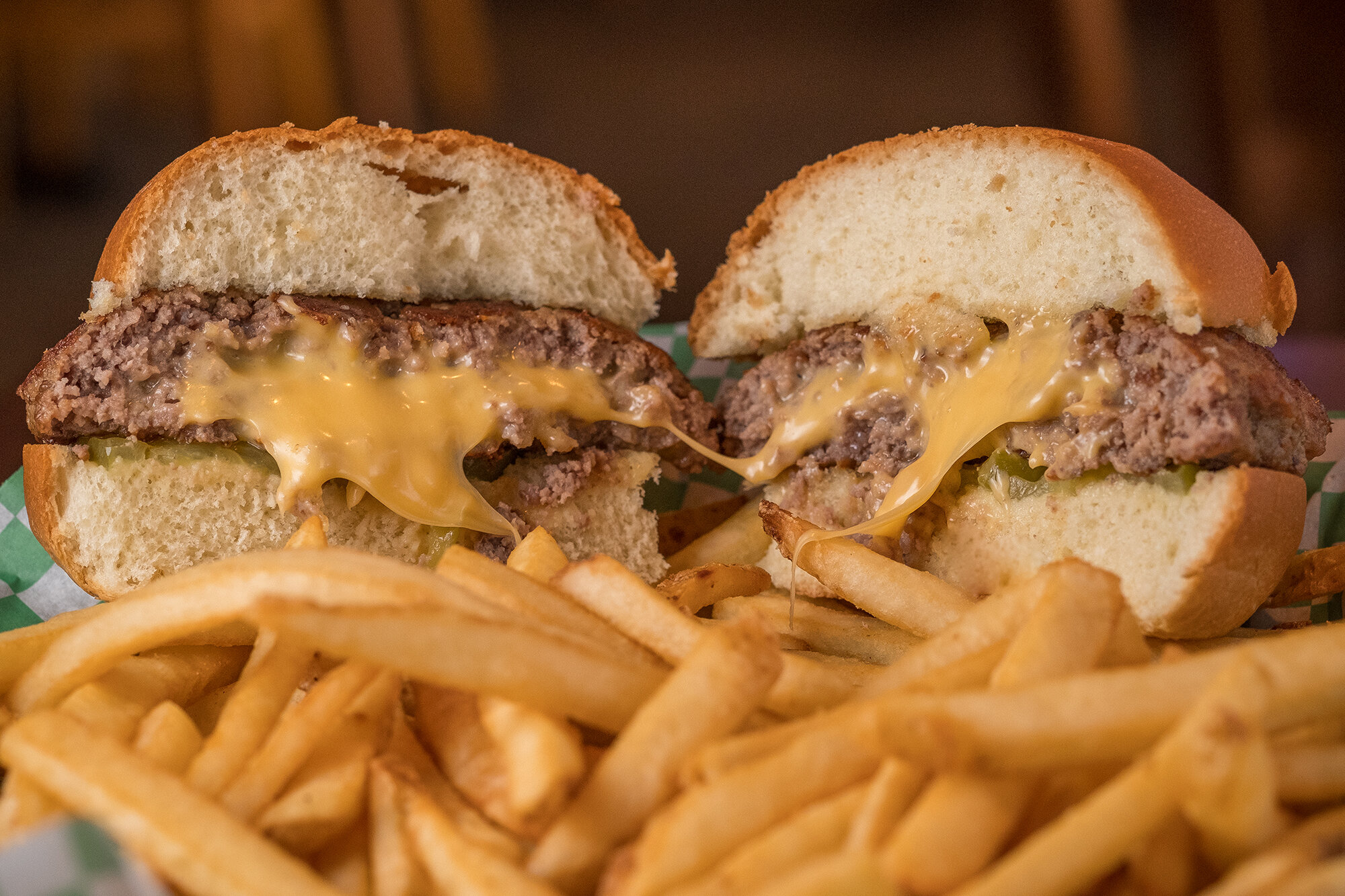
A Juicy Lucy from the 5-8 Club, the Twin Cities’ Home of the Juicy Lucy®, is Minneapolis’ contribution to American food culture. Our burgers are stuffed full of cheese and grilled to a sizzle. To top it off, we serve our cheesy creations on a bakery fresh bun. From the classic Juicy Lucy stuffed with American cheese that rivals imitate, but no one duplicates, to our rotating features, we have a Juicy Lucy for all burger lovers. Enjoy! And remember, be careful & take your time – the cheese is HOT!
From Speakeasy to Home of the Juicy Lucy®!
In 1928, at the height of Prohibition, the 5-8 Club originally opened in Minneapolis as a speakeasy serving beer and liquor illegally, along with a light food menu to its thirsty patrons. It was known as the 58th Street Club, located out in the country and just adjacent to the new Wold-Chamberlain Airport. Combined with its location, the fact that the building had an underground garage made it a particularly desirable “speak.” Cars, their trunks filled with bottles of illegal hooch packed in burlap bags, could pull right into the underground garage and the “goods” could be taken upstairs. If you want a genuine Juicy Lucy experience in the Twin Cities, there is no better place to go than a 5-8 restaurant. From our original location in South Minneapolis’ Nokomis neighborhood to Maplewood, Champlin, and West St. Paul, we look forward to welcoming you to Minnesota’s Home of the Juicy Lucy®.
To see the 5-8 circa 1930, watch the video above.
As Seen on TV
Our signature item, the Juicy Lucy, has transformed the way America sees cheeseburgers. Featured on several syndicated national TV shows, our burger stuffed with cheese has gained international attention. Adam Richman’s Man v. Food let the world know what Twin Cities burger lovers already did. In 2014, the Travel Channel’s Chow Down Count Down ranked the 5-8 #1 in America for tastiest place to chow down. Time Magazine also listed the Juicy Lucy as one of the most influential burgers of all time. City Pages listed eating a Juicy Lucy at the 5-8 as #15 on its comprehensive Twin Cities bucket list, “50 Things To Do Before You Die.” And, when Jimmy Fallon and his crew visited for Super Bowl LII in 2018, he reminded a national audience why the Juicy Lucy is so beloved. These honors would not be possible without our loyal Juicy Lucy fans! Thank you for helping us achieve recognition as the best Juicy Lucy restaurant in the Twin Cities.
Featured on